Does a Child Need to Be Perfect Before Performing on Stage?
Jignasa Owner ·
Jignasa World · Theatre , Vocals , Music & Dance Classes in Nallagandla , Tellapur & Lingampally · Ages 5–15
A Complete Parent’s Guide to Stage Performance for Kids
Here’s the honest answer: no, a child doesn’t need to be perfect before performing on stage — and waiting for perfect often costs more than it protects. Skill can always catch up later in life. Confidence built at a young age doesn’t work the same way — it stays with a child for life. That’s the real reason performing early matters more than performing flawlessly.
whether you’re looking for stage performance opportunities for kids or exploring extracurricular activities for kids in nallagandla , or simply wondering when your child should start performing, here’s what to actually look for.
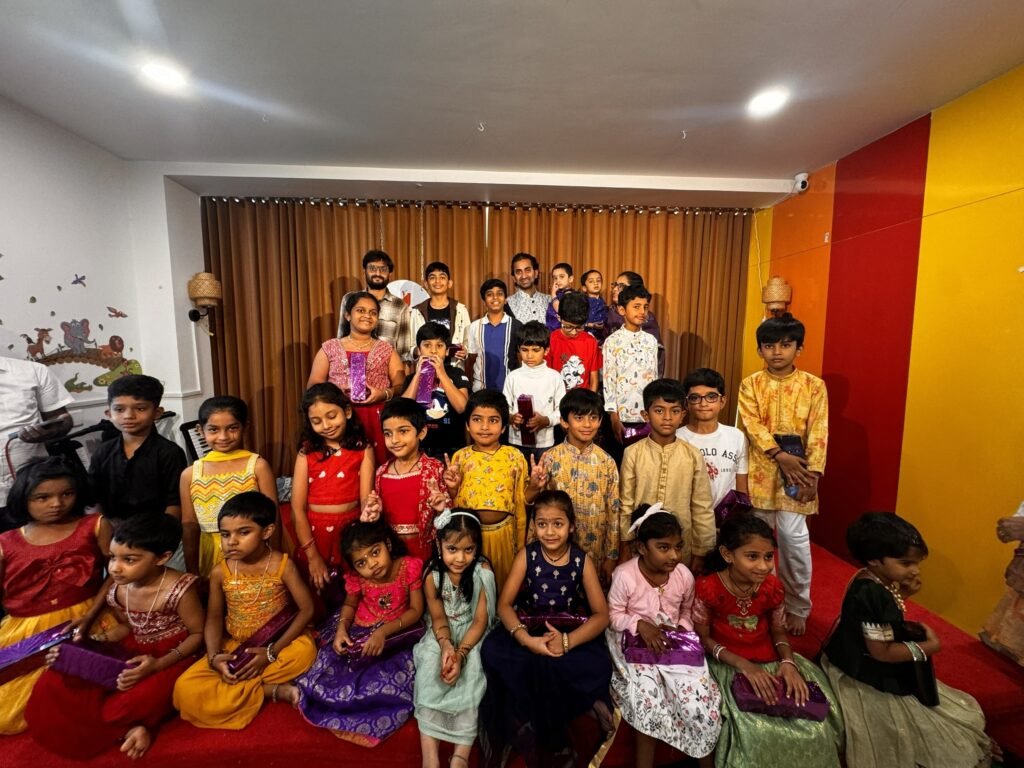
“Children performing on stage at Jignasa World in Nallagandla”
Why Parents Feel Their Child Isn’t Ready
It’s natural to want to protect your child from embarrassment. Before a first performance, most parents think some version of: “They’re still learning,” “They’re not confident enough yet,” “What if they forget everything on stage?”
These concerns come from one assumption — that confidence has to come before the stage. Often, the opposite happens: a child steps onto the stage despite feeling nervous, completes the performance, and realises, “I was scared, but I still did it.” That single experience often makes the next performance easier than the first.
Confidence Follows Performance — Not the Other Way Around
Think about how children learn any skill: they don’t become excellent first and then start practising — they learn, make mistakes, get guidance, and try again. Performance works the same way.
A child learning singing may miss a note. A child in a play may pause before remembering a line. None of that means they shouldn’t be performing — the point of an age-appropriate performance isn’t to prove mastery, it’s to give the child the experience of standing in front of people, surviving it, and finding it less frightening the next time.
That’s really what confidence-building looks like here — not a fearless child, but achild who slowly becomes comfortable performing in front of others.
“A child doesn’t need confidence to step onto the stage. Sometimes, stepping onto the stage is how confidence begins.”
What Actually Happens When Children Perform on Stage?
A stage performance may last only a few minutes, but the learning experience begins much earlier.
A child usually goes through something like:
Learning → Practising → Rehearsing → Feeling nervous → Performing → Reflecting → Trying again
Before their first performance, the stage may feel completely unfamiliar.
Does Stage Performance Build Confidence?
It can, especially when children receive age-appropriate opportunities to perform in a supportive environment.
Stage confidence doesn’t necessarily mean becoming fearless or suddenly becoming the most outgoing child in the room.
It can develop through small experiences.
Confidence tends to show up in small, specific ways — a child who once avoided the microphone starts holding it comfortably; one who struggled to face the audience begins looking up more; another who froze mid-line learns to pause, recover, and keep going.
Each experience gives the child an opportunity to discover what they are capable of handling.
This is why stage performance for kids can be more than entertainment.
It can become another part of the learning process.
What If a Child Makes a Mistake on Stage?
They probably will at some point. And that’s okay.
A child might:
- Forget a line
- Miss a dance step
- Sing the wrong note
- Lose their place
- Speak too quietly
- Start before the music
- Forget what comes next
After experiencing it once, some of that uncertainty becomes familiar.
Most importantly, they know:
«”I was nervous, but I managed to do it.”»
That experience can make future performances easier to approach.
The goal isn’t to make a child completely fearless.
The goal is to help them become comfortable performing even when they feel a little nervous.
Should Shy Children Perform on Stage?
Yes — but gradually, not by being pushed straight into a big performance. A shy child benefits from working up through smaller steps: practising at home, performing for a parent, then a teacher, then a small group, then a classroom showcase, and only later a larger audience.
The goal isn’t to turn a quiet child into an extrovert. A child can stay naturally quiet and still become comfortable performing — confidence doesn’t have to look loud.
How Parents Can Help
- Start small — a classroom or family audience before a bigger stage
- Normalize nerves — even experienced performers feel them
- Praise effort, not perfection — “you went up there and finished” matters more than “you were perfect”
- Avoid over-rehearsing right before the performance — it often raises anxiety instead of lowering it
- Stay calm if something goes wrong — kids look to parents to gauge how serious a mistake is; a relaxed reaction tells them it’s okay
- Afterward, ask how it felt, not what went wrong — “how did you feel on stage?” opens reflection; “did you make mistakes?” invites judgment.
Jignasa Spotlight: Real Stage Experience for Young Performers
This is exactly the philosophy behind Jignasa Spotlight , a recent event organised for Jignasa’s vocal and music students. The idea wasn’t to put on a polished show — it was to give children genuine stage experience, let parents see their child’s learning first-hand, and help young performers get more comfortable presenting what they’d practised in front of a real audience.
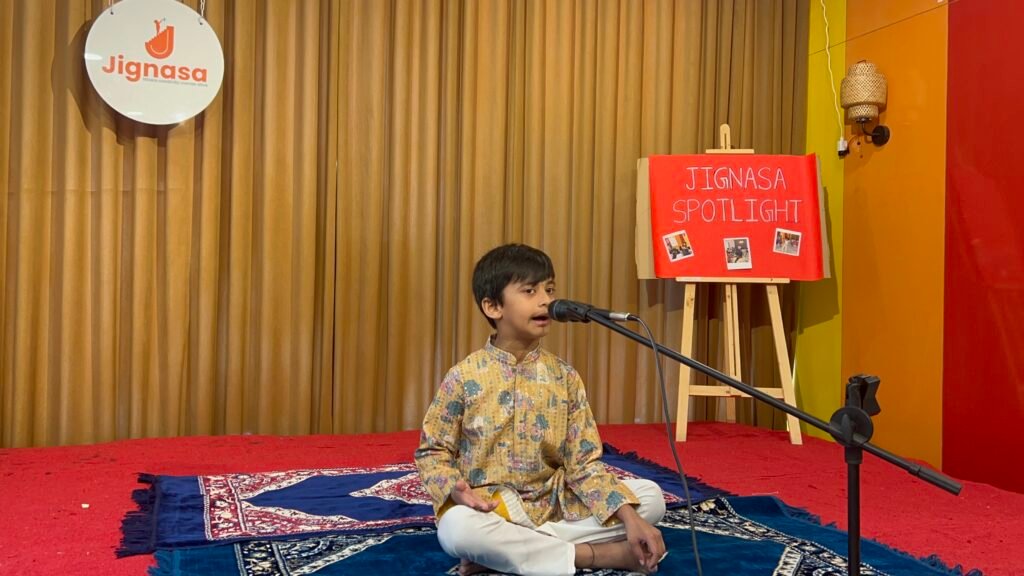
For the students, it meant taking what they’d learned in class and experiencing it in a real performance setting — remembering their material, responding to the moment, and presenting it in front of others. For parents, it meant seeing the actual progress behind the practice, not just hearing about it.
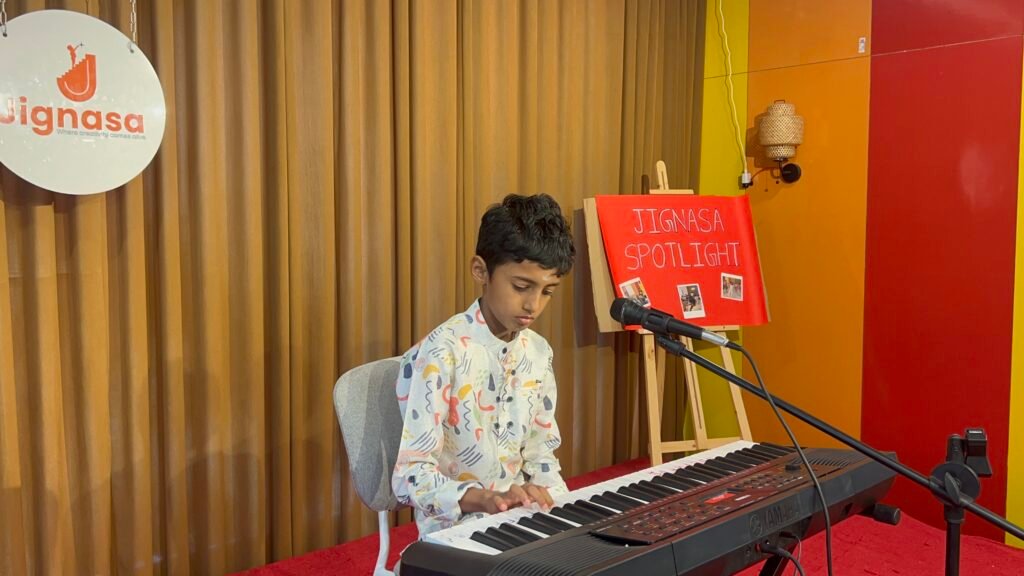
Nobody at Jignasa Spotlight was expected to be flawless. The point was the same one this whole guide is built on: children don’t need to be perfect to perform — performing is part of how they get there.
Performance Isn’t Limited to One Activity
Performance can take many forms. At Jignasa, children get opportunities to build confidence through theatre, dance, music, and public speaking.
- Theatre — Rang Manch , led by Eugien Jos Chirammel (Canopy Theatre, 300+ productions, 1,000+ students trained) — acting, voice, storytelling, improvisation
- Dance — Nritya Kala , led by Dr. K. Vijayalakshmi — rhythm, expression, and stage exposure through showcases and recitals
- Music — Music Classes , with mentorship from Kalyan Vasanth and Naren RK Siddarth, building toward events like Jignasa Spotlight
- Public Speaking — Personality Development Classes , impromptu speaking, and presentation practice, since standing in front of a group and communicating an idea is a performance skill in its own right
Frequently Asked Questions
Does a child need to be good before performing on stage?
Should shy children be pushed to perform?
What if my child forgets their lines or steps on stage?
What are the benefits of stage performance for kids?
Where can my child get stage performance experience in Nallagandla?
What is Jignasa Spotlight?

Ready to Give Your Child Their First Stage Experience?
Don’t wait for your child to become perfect.
Give them an opportunity to learn, practise, try, make mistakes, recover and discover what they are capable of.
At Jignasa World, performance is part of the learning journey — whether your child explores theatre through Rang Manch, classical dance through Nritya Kala, music through vocal and instrumental programmes, or public speaking through communication-focused classes.
💬 Book a Free Demo Class at Jignasa World
Let your child take their first step towards the stage.
Jignasa Activity Centre · Nallagandla, Hyderabad.
Vocal Classes · Guitar Classes · Keyboard Classes · Chess Classes · Kuchipudi Dance · Public Speaking · Arts Club · Theatre classes